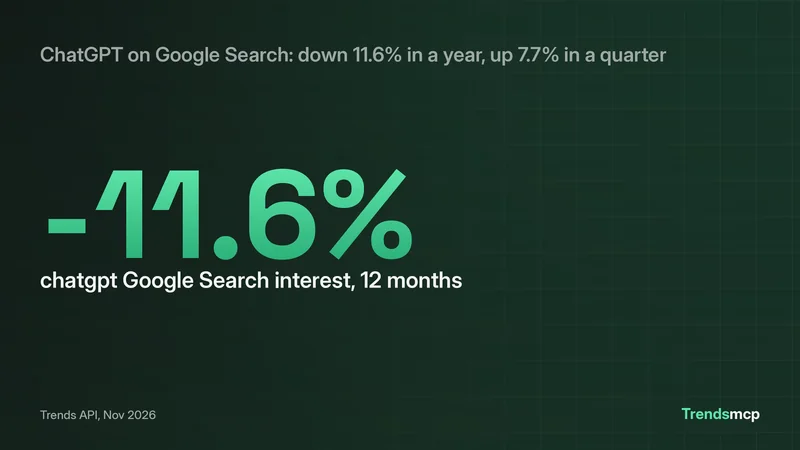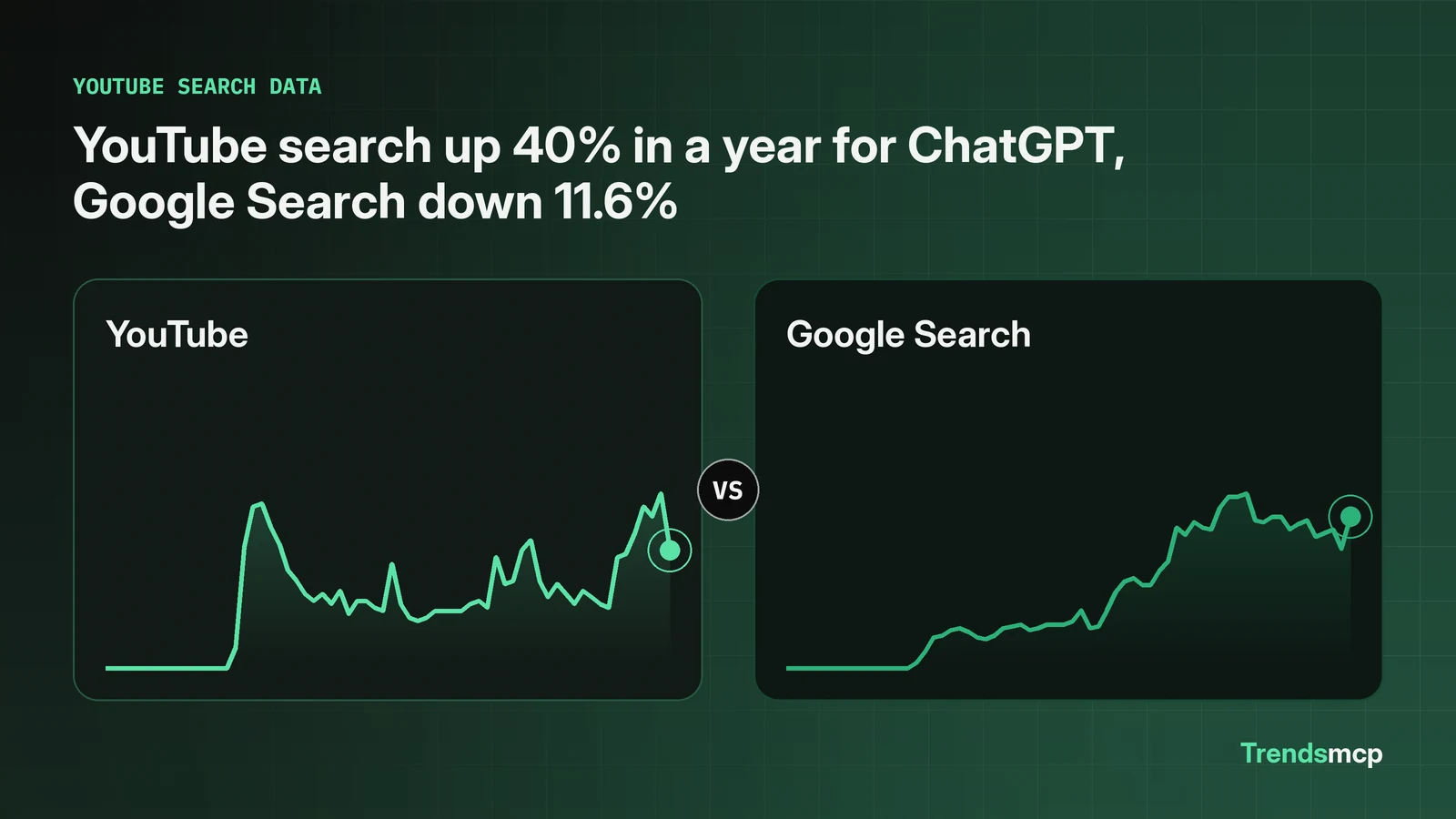
YouTube search trends measure what viewers type into the YouTube search bar: a demand signal that is distinct from web search. On November 4, 2026, YouTube search interest in "chatgpt" sat 40% above its level a year earlier, while Google Search interest was 11.6% lower. The split is the story, and it suggests viewers may be hunting tutorials, reviews, and walkthroughs on YouTube. The numbers below come from a live Trends API pull on 2026-11-04, and the piece ends with the exact call that retrieves them.
The split the two search bars tell
YouTube search interest in "chatgpt" rose 20.7% over the last three months and 40% over the last twelve, from an index of 25 on November 1, 2025 to 35 on October 31, 2026. Over the same twelve months, Google Search interest fell 11.6%, from 95 to 84. The three-month Google number did tick up 7.7%, so this is not a collapse in web interest, it is a divergence: steady on one surface, accelerating on the other.
| Window | YouTube | Google Search |
|---|---|---|
| 3 months | +20.7% (29 to 35) | +7.7% (78 to 84) |
| 12 months | +40.0% (25 to 35) | -11.6% (95 to 84) |
Growth here is point-to-point: the most recent weekly value against the value one window earlier. This suggests, rather than proves, that ChatGPT's audience shifted from "what is it" web searches toward "show me how" video searches. A second check backs the pattern: for "gta 6", YouTube interest rose 250% year over year while Google Search rose 483%. Different topics diverge in different directions, which is exactly why pulling both sources matters.
One limit to keep in view: the index is relative, scaled 0 to 100 per source. A 40% rise on YouTube does not mean 40% more searches than Google. It means the topic's share of attention on YouTube grew by that much.
What viewers are searching around right now
The YouTube Trending board for the United States on November 4, 2026 shows what is being watched right now at this moment: music videos (Bedjine, Sean Rii, Grupo Firme), game trailers (the Elder Scrolls VI name reveal, an Xbox sweepstakes trailer), esports (TES vs IG at Worlds 2026), a TV trailer (Percy Jackson season 3), and a seasonal Christmas playlist ranked 13th on November 4.
| Rank | Video | Writer's read |
|---|---|---|
| 1 | BEDJINE, J'AVOUE (official video) | Music |
| 3 | The Elder Scrolls VI: Official Name Reveal | Gaming |
| 4 | Eagles, Hotel California (lyrics) | Music |
| 8 | Honest Trailers, Monsters, Inc. | Film |
| 9 | TES vs IG, Worlds 2026 quarterfinals | Esports |
| 11 | Xbox Series X-Bite sweepstakes trailer | Gaming |
| 13 | Top 50 Christmas songs playlist | Seasonal |
| 14 | Percy Jackson season 3 trailer, Disney+ | TV |
Treat this board as a different instrument from search trends. Trending ranks what is being watched right now, while the search-interest index measures typed intent. A creator reading both gets the full picture: the board says what viewers are watching today, and the search index says what viewers are actively looking for. For a deeper look at the raw board, the YouTube trends data set documents what each row carries.
Pull YouTube search trends in one call
The figures above come from two calls. The first compares growth across sources in one request:
{
  "tool": "get_growth",
  "keyword": "chatgpt",
  "source": "YouTube, Google Search",
  "percent_growth": ["3M", "12M"]
}
The second pulls the full five-year weekly history for the chart:
{
  "tool": "get_time_series",
  "keyword": "chatgpt",
  "source": "YouTube"
}
The REST equivalent is one POST per call:
curl -X POST https://api.trendsmcp.ai/api \
  -H "Authorization: Bearer YOUR_KEY" \
  -H "Content-Type: application/json" \
  -d '{"mode": "get_growth", "keyword": "chatgpt", "source": "YouTube, Google Search", "percent_growth": ["3M", "12M"]}'
The full parameter reference lives in the Trends API data catalog.
Connect either form to an AI assistant and the assistant can run the whole comparison in a sentence: ask it to "compare YouTube and Google Search interest for my keyword over the last 12 months" and it makes the call, reads the growth rows, and flags the divergence. The MCP setup guide has the connection steps, and YouTube search data explains how the source differs from the trending board. For the head-to-head page format, Google Search vs YouTube keeps the comparison live.