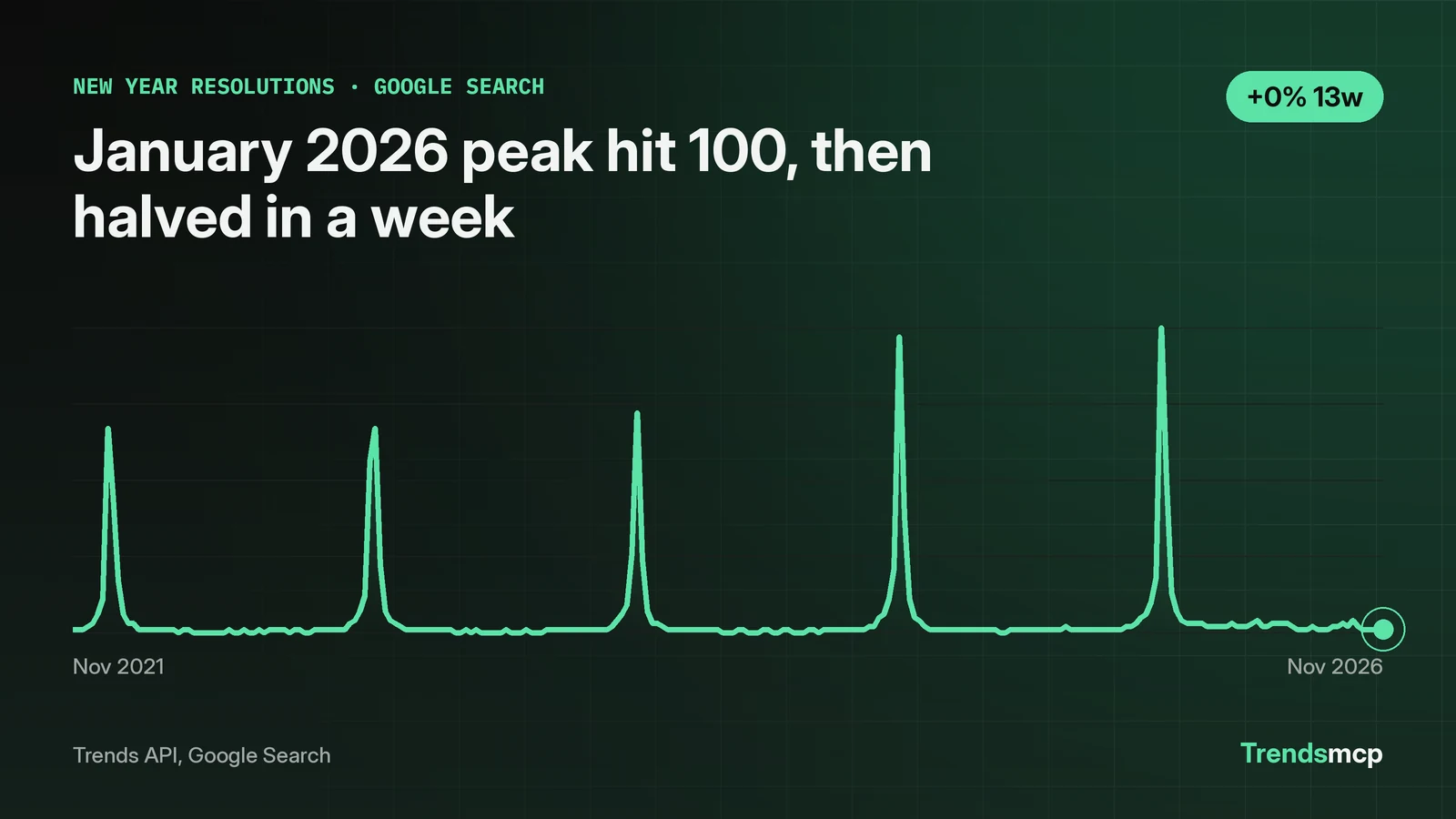
Search interest in new year resolutions shows the sharpest spike in this term's own five-year series. The term sat at an index of 1 in the week of November 7, 2026. If the last five years repeat, it will climb through December and peak in the first week of January. The January 2026 peak hit the maximum index of 100, the highest week in the 261-week series, and 49.3% above the January 2022 peak of 67. The spike is brief: the peak week carried 57.5% of the first five January weeks combined, and interest halved within a week. Neighbouring terms split: "new year goals" rose early and faded slowly, while "new year resolution ideas" fell 59% from its 2023 peak. Keyword Planner puts the parent phrase at 135,000 monthly searches, so the audience is large and the window is short.
The January peak keeps climbing, with one flat year
Five January peaks in a row, rising in three of the four steps between them and tying once.
| January | Peak week | Index |
|---|---|---|
| 2022 | week of Jan 1 | 67 |
| 2023 | week of Jan 7 | 67 |
| 2024 | week of Jan 6 | 72 |
| 2025 | week of Jan 4 | 97 |
| 2026 | week of Jan 3 | 100 |
The 2026 peak sits 49.3% above the 2022 peak. The index is normalized to the five-year maximum, so 100 is the highest week in the window by definition, and the year-over-year comparison holds inside this one series. The pattern is growth at the top, uneven year to year: the peak moved from 67 to 72 to 97 to 100 across the last four Januaries, with 2023 the only flat year.
December stays quiet until the last two weeks
Interest barely moves for most of December. In the 2025 run-up the index read 5 in the week of December 6, 6 on December 13, 10 on December 20, 18 on December 27, then 100 in the week of January 3. The 2024 run-up traced the same shape: 5, 6, 11, 21, then 97.
The first week at 10 or above landed between December 20 and December 30 in all five cycles: December 25, 2021 (11), December 24, 2022 (12), December 30, 2023 (26), December 21, 2024 (11), December 20, 2025 (10). A reader planning content or a campaign around this term gets almost nothing from early December; the demand arrives in the last two weeks of the month.
The peak week carries more than half of January
January 2026 read 100, 50, 13, 7, 4 across its five weeks. The peak week alone holds 57.5% of that five-week total of 174. Interest halves in a single week, then drops to 13 by the third week.
The concentration shows in the full series too: only 21 of 261 weeks reached 10 or above, and only 7 reached 50 or above. Outside the window the term nearly vanishes. The index sits at 0 or 1 most weeks outside the window: 44 of the 261 weeks read 0, and the highest week from February through November 2026 was 4. The sharp part of the event is two weeks wide, and the first week is the event.
The neighbours split: goals rise early, idea lists fade
Two neighbouring terms trace two different shapes. "New year goals" peaked in January at 39 in 2022, 48 in 2023, 52 in 2024, 57 in 2025, and 100 in 2026. Each term's series is normalized to its own five-year maximum, so the two 100s are not comparable across terms; only the shape inside each series compares.
Unlike the head term, goals demand starts in November. The weeks of November 1 to 29, 2025 read 10, 14, 19, 20 and 19. The matching 2026 readings came in lower, at 5 for the week starting October 31 and 4 for the week starting November 7. Across those two November weeks the growth tool's 12-month figure is minus 71.43% (14.0 on November 8, 2025 against 4.0 on November 7, 2026). Both endpoints are pre-season November weeks, so the figure describes the early ramp, not the January peak. December 2025 for goals ran 26, 27, 30, 25 before the January peak of 100, and the fade was slower: 100, 47, 27, 28. Goals demand arrives earlier and fades slower than resolutions demand.
"New year resolution ideas" moves the other way. Its January peaks were 69 in 2022, 100 in 2023, 86 in 2024, 56 in 2025, and 41 in 2026, down 59% from its January 2023 peak. This suggests readers still search the head phrase more than ever but search less for lists of ideas, as if the resolution is chosen before the search begins. That is an inference from the two series, not a measured fact about reader intent.
Run the same read for any seasonal term
Three call types reproduce every number on this page: six calls in total, all run on November 13, 2026. Hooked up to the MCP server, an assistant can pull the series with this call:
get_time_series
  keyword: "new year resolutions"
  source: "Google Search"
The growth call adds the 3-month and 12-month windows, and Keyword Planner supplies the monthly volumes. Over REST, the same request goes out as a single POST to https://api.trendsmcp.ai/api carrying mode get_time_series. The walkthrough for the Google Trends API in Python loops the call over a keyword list, and the Google search trends topic shows the same treatment for the tool itself. The Cyber Monday demand report runs the same calls on a shopping event, which makes a useful contrast: a shopping spike builds for weeks, while the resolutions spike jumps from 18 to 100 in a single week.
python tools/trends.py series --keyword "new year resolutions" --source "Google Search"
python tools/trends.py growth --keyword "new year resolutions" --source "Google Search" --windows 3M 12M
python tools/keywords.py volumes "new year resolutions" "new year resolution trends" "new year goals"
What the index does not prove
The index is relative, not a count: 100 means the most searched week in the five-year window, and every other week is a fraction of it. Keyword Planner supplies the scale, 135,000 monthly searches for the parent phrase.
The 3-month and 12-month growth figures for "new year resolutions" both read 0.0%, because both endpoints are off-season trough weeks at 1.0. Point-to-point windows mislead on seasonal terms; the shape of the series is the finding, not the growth percentages.
The spike shows when curiosity surges, not why. No cause is claimed for the rise. January 2027 is untested: five straight years of the same shape is evidence the pattern repeats, not a guarantee.
One more honest note: the target keyword "new year resolution trends" itself draws 0 monthly searches in Keyword Planner. The demand sits in the parent phrase "new year resolutions" at 135,000. The page answers the trends question behind that parent phrase.