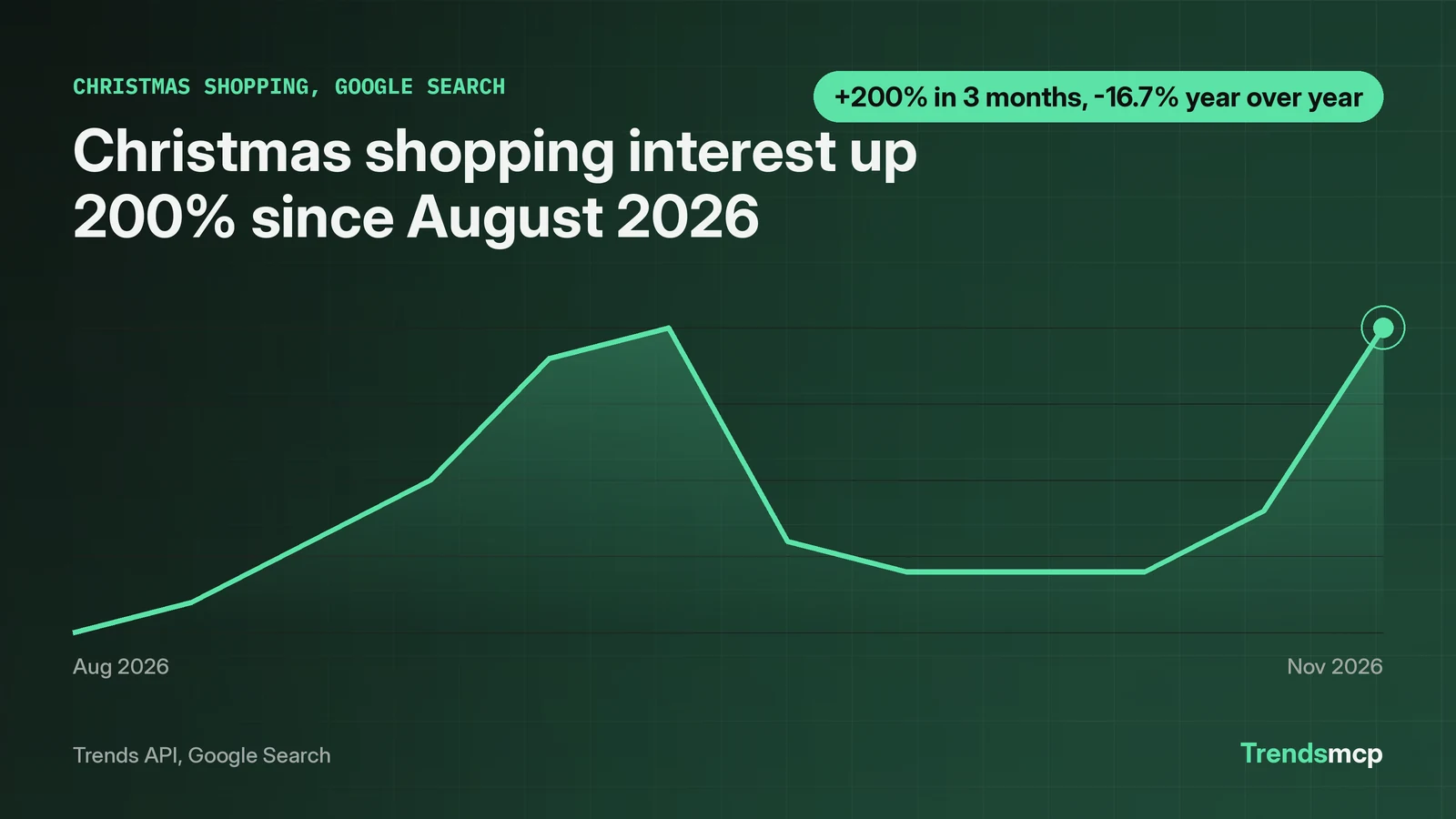
Christmas shopping search interest reached 15 on the 0 to 100 index for the week ending November 7, 2026, after reading 5 in August. That is a 200% rise in three months. Every shopping term measured still trails the same week last year: Christmas shopping sits 16.7% below November 2025, Christmas gifts 14.3% below, Black Friday 10% below, and Cyber Monday 27.3% below. Past seasons point to the peak still lying ahead: in all five seasons on record the term peaked in December, and last year it hit the five year maximum of 100 on December 27. No shopping term appears in the Google top 10 as of November 4, and Amazon's top rated list is still everyday staples. The climb has started. The peak has not.
Seven of eight terms rose since August
Seven of the eight terms rose in the last three months, and all eight trail the same week last year. Holiday shopping was the exception, flat at 14. Eight shopping terms were measured on Google Search. Christmas shopping and Black Friday each carry 261 weekly points over five years in the saved data. The table below gives the latest value, the three month change, and the twelve month change for each term. Data runs to November 7, 2026, except Black Friday, which runs to October 31.
| Term | Latest value | 3 month change | 12 month change |
|---|---|---|---|
| Christmas shopping | 15 | +200% | -16.7% |
| Christmas gifts | 24 | +200% | -14.3% |
| Black Friday | 9 | +350% | -10.0% |
| Cyber Monday | 8 | +300% | -27.3% |
| Gift ideas | 21 | +10.5% | -38.2% |
| Christmas deals | 21 | +90.9% | -4.5% |
| Holiday shopping | 14 | 0% | -62.2% |
| Christmas gift ideas | 20 | +400% | -13.0% |
The three month rises look dramatic because the baselines sit in August. Black Friday rose from 2 to 9, Christmas gift ideas from 4 to 20. Those are real climbs from a low floor, not signs of a record season. The twelve month column is the stricter test, and it fails everywhere. Holiday shopping is the weakest of the eight, flat over three months at 14 and down 62.2% on last year, when the same week read 37. Christmas deals is the closest to last year, down only 4.5% from 22 to 21.
Weekly values for Christmas shopping tell the same story in finer detail. Interest rose from 5 on August 22 through 15 on September 26, then read 8, 7, 7, 7, and 9 through the five October weeks, and jumped again to 15 in the week of November 7. October was a pause, not a collapse. The November jump is the first reading that matches the late September high.
December peaks cluster in late December
Christmas shopping peaked in December in all five seasons on record. The annual peaks fell on December 25, 2021, December 24, 2022, December 23, 2023, December 28, 2024, and December 27, 2025. The December maximums were 61 in 2021, 56 in 2022, 54 in 2023, and 44 in 2024, a slow slide across four years. Then 2025 broke the pattern with a December maximum of 100, the highest value in the whole five year series, reached on December 27, two days after Christmas.
Black Friday follows a sharper script. Its five year peak is 100 in the week of November 27, 2021. December readings after the first week fall to between 1 and 3 every year, since the day itself is the event; the first December week still reads 11 to 15. The latest reading, 9 in the week of October 31, 2026, is up from 2 in mid August and still below the 10 recorded in the same week of 2025. Black Friday 2026 falls on Friday, November 27, about four weeks after the latest reading.
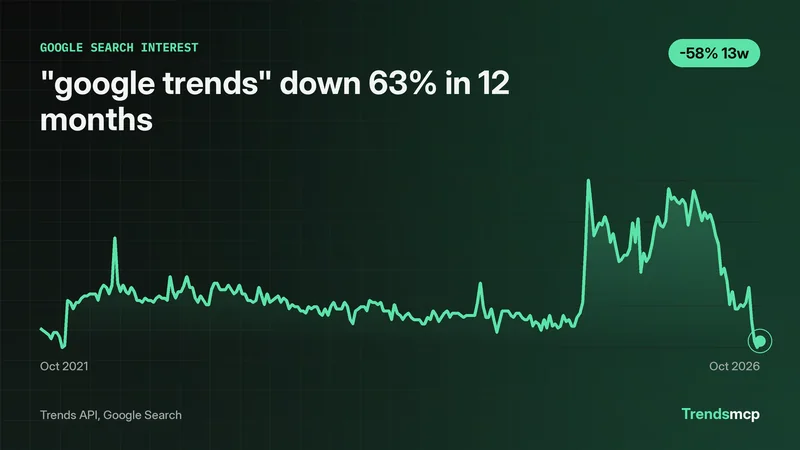
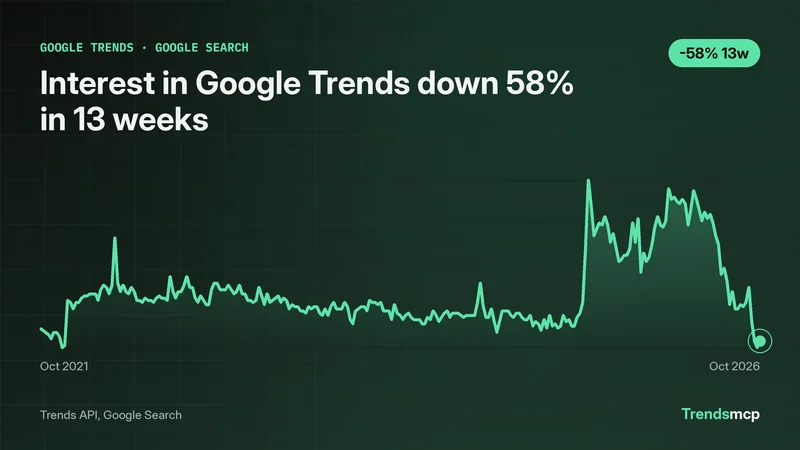
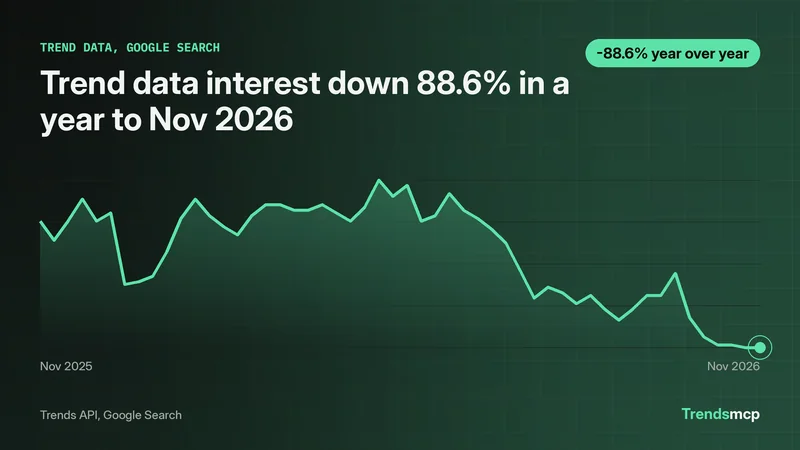
One caution belongs on the year over year numbers. The December 2025 peak of 100 stands far above the 44 to 61 range of the four prior Decembers. A similar step up in August 2025 shows in two unrelated terms measured in the same system: "trend data" averaged 7.8 in July 2025 and 62.8 in August, and "google trends data" averaged 10.0 in July and 58.2 in August. The data cannot say why. The honest read is that 2025 was a strong baseline by this measure, and the 2026 shortfall against it may say more about the baseline than about shopper demand.
Gift ideas lead the early climb
Christmas gift ideas is the fastest riser of the eight terms, up 400% in three months from 4 to 20. That pattern suggests people start the season by asking what to buy, and only later by asking where to buy it cheap, though the growth gap alone cannot prove the order. Christmas deals, the price led term, rose 90.9% over the same stretch, from 11 to 21. Gift ideas rose only 10.5% in three months and sits 38.2% below last year, the second weakest twelve month reading after holiday shopping. That pattern suggests early season searches are specific, with generic terms likely to catch up once the deal weeks arrive. The data so far cannot prove the second half.
Search volume from Keyword Planner frames the same split. Christmas gift ideas draws 135,000 monthly searches with high competition, Christmas shopping 12,100 with high competition, and holiday shopping 2,900 with medium competition. The exact phrase this report answers, Christmas shopping trends, draws only 10 monthly searches with low competition.
Shoppers have not reached the front page yet
Google's trending searches board as of November 4, 2026 carries no shopping term in its top 10. Election results lead the board, with the 2026 US election results at number 1. Three of the ten are Senate or voting queries: the Michigan Senate race, where to vote, and Ohio election results. The rest mix candidate names, Native American Heritage Month, a plane crash, a clock query, and Abdul El-Sayed. Shopping interest is climbing in its own lane. It has not crossed into the general news cycle.
Amazon's best sellers tell the same story from the buying side. The top rated list as of November 9, 2026 is everyday staples. Three of the top 10 are battery listings: Amazon Basics AAA batteries at number 1, a 48-pack of Amazon Basics AA batteries at number 2, and a 20-pack of Amazon Basics AA batteries at number 9. Verity sits at number 3. The rest of the list holds bedding, clothing, cosmetics, and detergent. No gift item appears in the top 10 at all. Shoppers are searching for gifts, but the top rated list as of November 9 shows none among its top 10.
Reproduce the table with one call pattern
Sixteen calls reproduce the table, one series call and one growth call for each of the eight terms. Two more board calls check the top 10 lists. The figures in this report come from two sources, the Trends API and Keyword Planner. The series call returns about five years of weekly points for one keyword on one source. The growth call compares a recent point against a baseline three or twelve months back. The August 2025 step figures for "trend data" and "google trends data" need two further series calls, one per term, on top of the sixteen.
Using Trends MCP, get the time series for "christmas shopping"
on Google Search, then get growth for the same keyword over 3M and 12M.
The REST form is the same shape: get_time_series with keyword christmas shopping and source google search, then get_growth with windows 3M and 12M. The board calls are get_top_trends with type Google Trends and type Amazon Best Sellers Top Rated. Boards cost one request per ten rows, so each top 10 list costs one request. A reader who runs the sixteen series and growth calls, the two board calls, and a Keyword Planner volume lookup gets the same table, the same weekly series, and the same check on whether the peak has arrived. The August 2025 step check takes two more series calls, one for "trend data" and one for "google trends data". For a fuller walkthrough of pulling Google Trends data into an analysis, see the guide to pulling Google Trends data. The October trend velocity census gives the same treatment to the full October board, and the Google search trends topic page tracks the broad term behind this report. Google Trends analytics covers the analytics side of the same data.