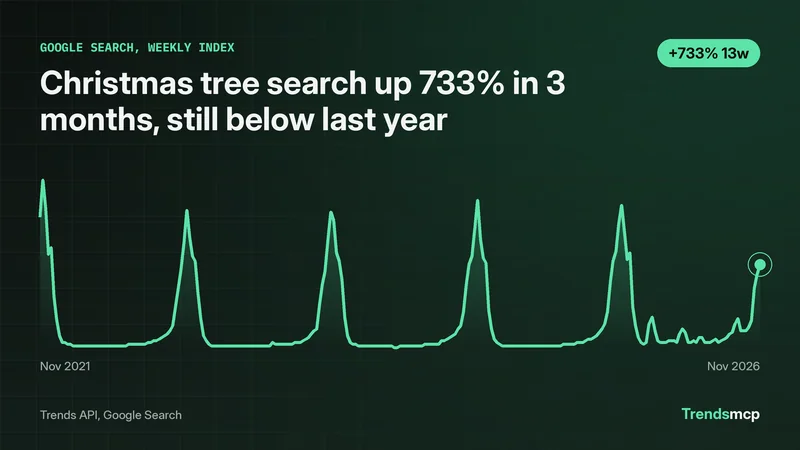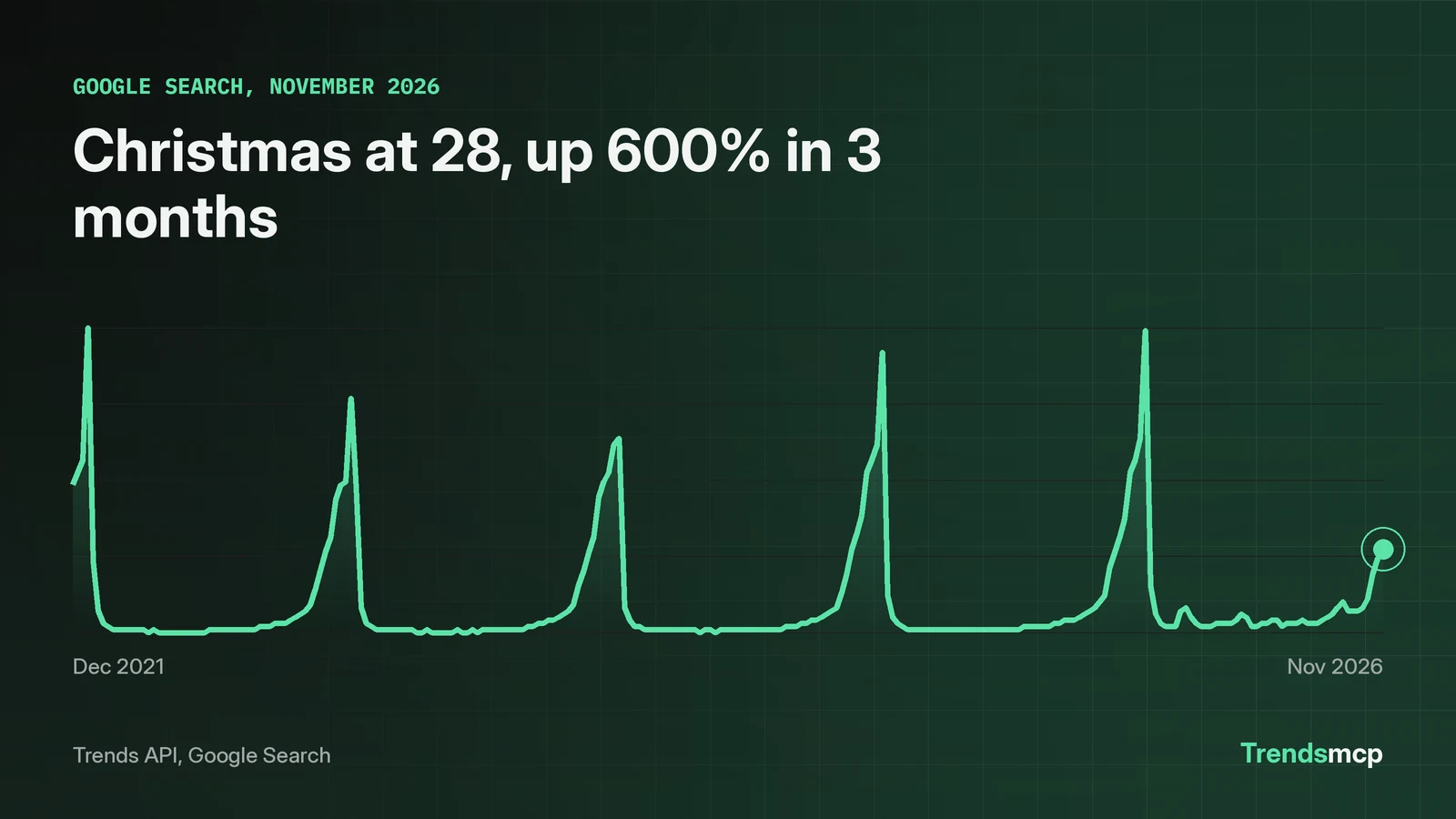
Christmas content publishes now, gym membership content in mid to late December 2026, and new year resolutions content by late December 2026, at least a week before January 1. The method: growth calls order the terms, and time series peak weeks date them. Those windows come from dated pulls run on November 28, 2026: christmas reads 28 on November 21, up 600% in 3 months from 4 and down 12.5% against 32 a year ago; gym membership reads 25, up 13.64% in 1 month and down 47.92% in 3 months; new year resolutions reads 1, flat over 3 months. January peak weeks date the later windows: gym membership peaks landed January 4 to 8 in 2022 to 2025 and January 31 in 2026, while new year resolutions peaks landed in the first week of January in all five years.
The prompt names terms, windows, output shape
The prompt forces Claude to return dated windows, a plan table and a limits statement. Claude decides when to call the trend tools, so the prompt names the terms, the source, the windows and the output shape:
Using TrendsMCP, check Google Search growth for "christmas", "gym membership" and "new year resolutions" over 1M, 3M and 12M. For gym membership and new year resolutions, also pull the time series and report the January peak week for each year from 2022 to 2026. Then build a content plan table with one row per term: publish window, index now, 3M growth, 12M growth, January peak week. State limits. Do not add causes.
The final sentence matters. Trend calls return index values and dates, not reasons, and a plan built on invented causes ages badly. The trend research prompts guide covers prompt shapes for other research jobs.
Three pulls produce three different windows
The three terms sit in three different seasonal positions, and the plan treats them differently:
| Term | Index, Nov 21, 2026 | 1M growth | 3M growth | 12M growth | January peak weeks, 2022 to 2026 | Publish window |
|---|---|---|---|---|---|---|
| Christmas | 28 | +211.11% (9 to 28) | +600% (4 to 28) | -12.5% (32 to 28) | December peak; January not used | Late November 2026 |
| Gym membership | 25 | +13.64% (22 to 25) | -47.92% (48 to 25) | -19.35% (31 to 25) | Jan 8, Jan 7, Jan 6, Jan 4, Jan 31 | Mid to late December 2026 |
| New year resolutions | 1 | no 1M pull in table | 0% (1 to 1) | -50% (2 to 1) | Jan 1, Jan 7, Jan 6, Jan 4, Jan 3 | Late December 2026 |
Christmas content goes first. The weekly series shows the climb already under way: 12 in the week of October 31, 20 on November 7, 25 on November 14 and 28 on November 21. The 12M figure tempers the ramp: 28 sits below the 32 of November 22, 2025, so the season is building at a slightly lower level than last year. The seasonal query planning guide works through the two-window reading in full.
Gym membership waits until December 2026. Its January peak rose every year from 2022 to 2026: 19, 24, 27, 30 and 54. Four peaks landed January 4 to 8; the 2026 peak landed January 31. A mid-December publish date puts the piece in place before either peak shape arrives.
New year resolutions waits longest. The term reads 1 now, and its January peaks landed in the first week of January in all five years, at 65, 68, 67, 100 and 92. Three of the five peaks landed January 1 to 4, so the plan assumes at least a week of lead time and sets the window to publish by late December 2026. Inference: content published in late November 2026 would sit through the quiet weeks before the January spike.
Peak weeks set the publish windows, growth sets the order
The two call types answer different planning questions. Growth windows order the work: christmas at +600% over 3 months needs a piece now, while new year resolutions at 0% over 3 months can wait. Peak weeks date the work, and December build readings set the production start. Gym membership December averages ran 13.8 in 2022, 15.8 in 2023, 18.2 in 2024 and 38.5 in 2025, each below the January average that followed. Four peaks by January 8 argue for a mid-December publish date. The late 2026 peak argues against scheduling a follow-up in the first week of January and closing the topic there.
A plan row therefore carries both figures. The growth figure decides which term gets written first. The peak week decides the last safe publish date. A term with a distant January peak, like gym membership, goes into production early and publishes late, whatever its mixed growth windows show (+13.64% over 1M, -47.92% over 3M). A term already climbing into its season, like christmas at 28, publishes immediately. Sorting by 1M growth alone puts christmas first at +211.11% against gym membership at +13.64%, and the peak dates keep christmas first for a second reason: its season is already under way.
The January averages add a third check. Gym membership January averages rose from 16.4 in 2022 to 49.8 in 2026. That suggests the season strengthened across the whole month, not only in the peak week. One caveat: gym membership readings run high across 2026 in the saved series, reaching 100 on February 21, 2026, so part of the January rise reflects a year-round level shift. Averages are means of the weekly readings dated in each January, computed from the saved series. New year resolutions January averages ran 27.2, 25.8, 25.5, 39.0 and 33.0. A plan that budgets one piece per term can weight effort by that trend: the term with rising January averages earns the longer piece.
The plan table is the deliverable
Claude returns the plan as one table with dated evidence in each row. A finished row reads like this:
Gym membership. Publish mid to late December 2026. Index 25 on November 21, 2026, up 13.64% in 1 month from 22. January peaks: 19 in 2022, 24 in 2023, 27 in 2024, 30 in 2025, 54 in 2026. Limit: each term sits on its own 0 to 100 scale, and point to point growth compares single weeks.
That row can go straight into a content calendar. The analyze Google Trends data guide covers the analysis step for readers who want the series work behind the windows.
Re-pull dates keep the plan honest
The plan sets two re-pull dates: one in mid-December, when December readings for new year resolutions show whether the build matches earlier years, and one in the first week of January, when the peak weeks land. Each re-pull costs one growth call per term.
Two limits bound the worked plan. Growth percentages compare single weeks on spiky seasonal series, so the index beside each percentage carries more weight. No monthly search volume backs the plan, because the Keyword Planner call failed in this run. The windows rest on dated index readings alone, and the December re-pull is where a weak window gets corrected.