Trend research in Cursor starts with one entry in ~/.cursor/mcp.json: a trends-mcp object under mcpServers with URL https://api.trendsmcp.ai/mcp, transport http, and a Bearer key in the headers. After a full quit and restart, Agent can call get_top_trends for live boards and get_growth for keyword movement in the same chat as a code change. Four jobs below show the pattern: the GitHub board, an npm package check, a competitor term read, and a two-package comparison. The calls were pulled on Nov 25, 2026; the board snapshot is timed 09:01 UTC that day, while the npm and Google Search series end on Nov 21, 2026.
The config lives in ~/.cursor/mcp.json
The entry to add, inside mcpServers:
{
  "mcpServers": {
    "trends-mcp": {
      "url": "https://api.trendsmcp.ai/mcp",
      "transport": "http",
      "headers": {
        "Authorization": "Bearer YOUR_API_KEY"
      }
    }
  }
}
The Cursor connector page holds the same object and the Windows path, %USERPROFILE%\.cursor\mcp.json. Four details from that page decide whether the connection works. The key comes from the account page. The URL points at the api host; the www sign-in host used by claude.ai returns 401 in this file. Cursor needs a full quit after saving, since a window reload does not pick up new MCP headers in every build. A settings row without a tool result is not connected, so the first board or growth answer in chat is the proof that matters.
cursor/plugins sat fifth on the Nov 25 GitHub board
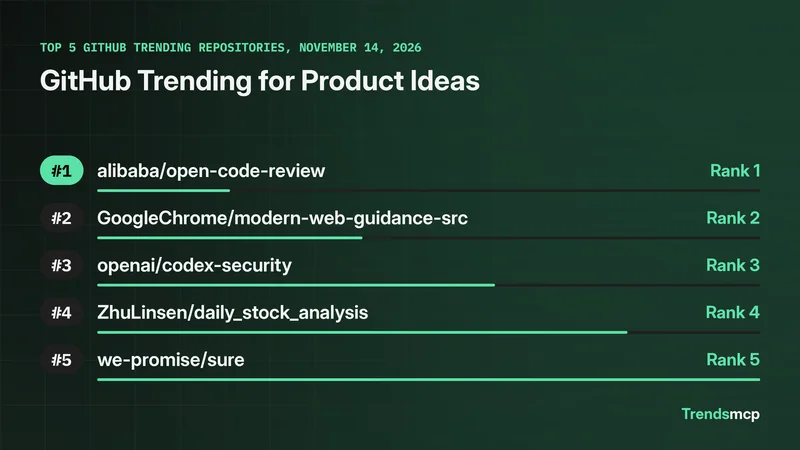
The GitHub board snapshot at 09:01 UTC on Nov 25, 2026 returned ten repositories:
| Rank | Repository | Rank | Repository |
|---|---|---|---|
| 1 | elementalsouls/Claude-BugHunter | 6 | firecrawl/firecrawl |
| 2 | obra/superpowers | 7 | nginx/nginx |
| 3 | HKUDS/CLI-Anything | 8 | openvinotoolkit/openvino |
| 4 | jingyaogong/minimind | 9 | cathrynlavery/diagram-design |
| 5 | cursor/plugins | 10 | mvanhorn/last30days-skill |
Using Trends MCP, call get_top_trends for the GitHub board, limit 10. List each repository with its rank and the snapshot time, then flag any repository that overlaps with this project.
The flagging step is where the board earns its keep in an editor. For a Cursor reader, the flagged row here is cursor/plugins at No. 5: the editor's own plugin repository sitting on the board is a dependency candidate or a competitor worth reading before a plugin feature gets planned. A repository that overlaps the current project is either a dependency candidate, a competitor worth reading, or a sign that a planned feature already exists in public. The snapshot time travels with the answer because the board is a dated snapshot, not a standing list: ranks from a morning pull should not be pasted into project files as if they were permanent.
The ai package ended Nov 21 far above its August level
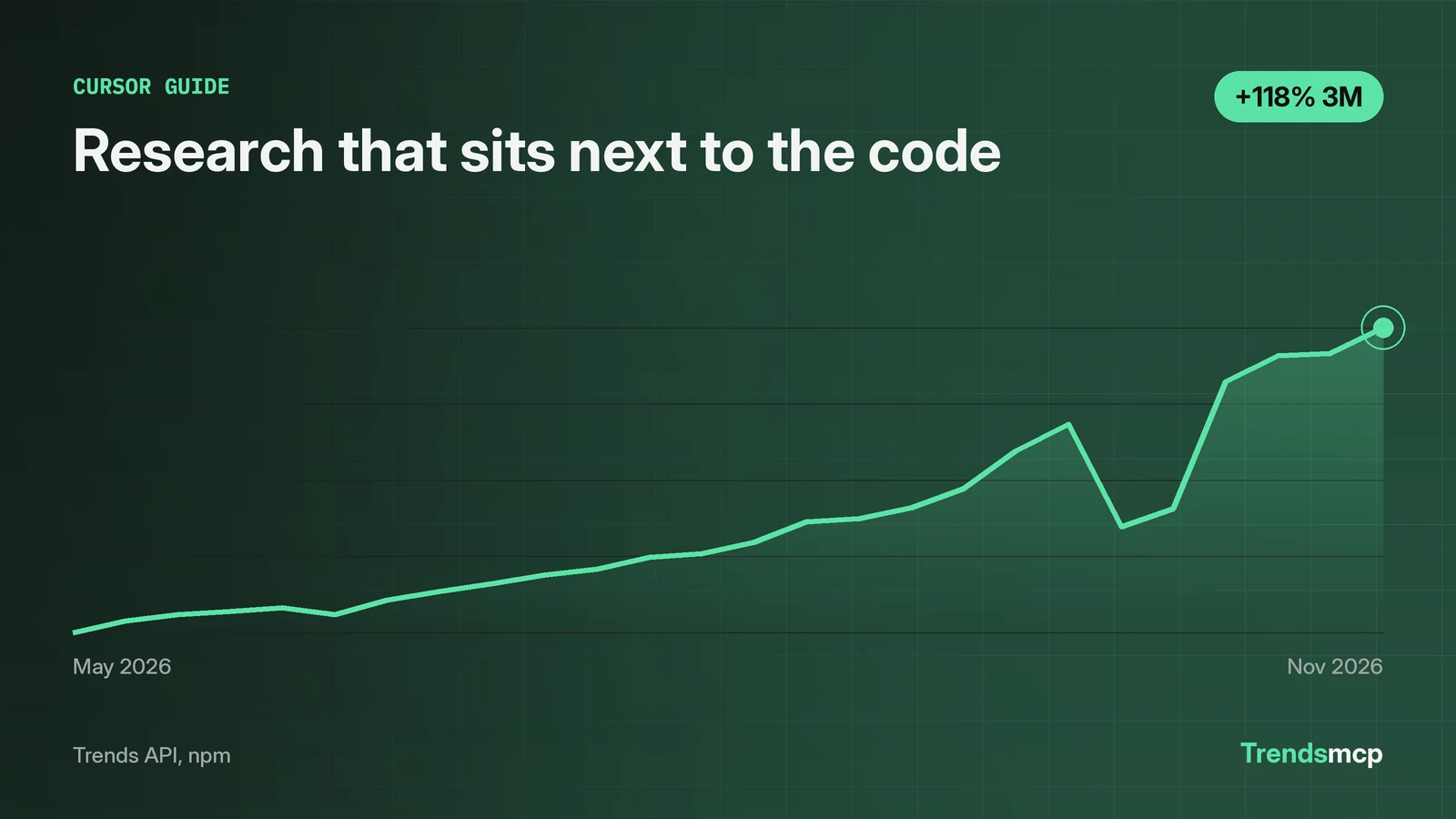
Downloads for the npm package ai reached 48,559,723 in the week ending Nov 21, 2026, with an index value of 100. Against the week ending Aug 22, 2026, when downloads read 22,242,372 and the index read 45.8, volume gained 118.32% over three months. The 12-month comparison starts lower: 5,076,594 downloads and an index of 10.5 in the week ending Nov 22, 2025, a volume gain of 856.54%. One prompt returns both windows:
Using Trends MCP, call get_growth for the npm package "ai" with windows 3M and 12M. Report the download volume and the index value at both dates for each window.
The series behind the call holds 260 weekly points, and its shape is not a straight climb. The index read 76.8 in the week ending Oct 10, 2026, fell to 52.2 the next week and 56.6 the week after, then recovered by the week ending Oct 31, 2026, when the index read 87.0, and kept climbing through the final four readings: 42,245,778 downloads that week, then 45,312,935, then 45,561,041, then 48,559,723. Read as inference rather than proof, the final four readings suggest growth resumed after an October dip; the dip itself is a reason to ask for the series, not only the growth percent, before a package becomes a dependency.
claude code flattened over three months
Search interest in "claude code" read 34 on Nov 21, 2026. A year earlier, on Nov 22, 2025, the same index read 13, which puts the 12-month change at plus 161.54%. The recent window reads differently: the index stood at 35 on Aug 22, 2026, so the 3-month change is minus 2.86%. Both readings come from one call:
Using Trends MCP, call get_growth for "claude code" on Google Search with windows 3M and 12M. Give both index values and both dates for each window, and say whether the recent window agrees with the yearly one.
Endpoint values alone cannot show the path between Aug 22 and Nov 21, 2026, and the honest reading stays at the endpoints: the yearly comparison shows a much higher level than a year earlier, while the recent comparison shows the level roughly unchanged across the quarter. For competitor timing, that pairing argues for checking the series before treating the yearly gain as current momentum. Because the call runs in the editor, the answer can land directly in a planning note or an issue comment while the reasoning is fresh.
Volume separates ai from langchain, the index does not
In the week ending Nov 21, 2026, the npm package ai recorded 48,559,723 downloads and langchain recorded 4,199,737. Both packages carry an index value of 100 on that date, so the index rows cannot rank them against each other; volume can, and the gap runs wider than ten to one. The growth rows differ too. For langchain, downloads climbed from 2,896,914 (week ending Aug 22, 2026) to 4,199,737, a 44.97% gain across three months. The yearly comparison starts at 1,259,118 downloads on Nov 22, 2025 and lands at a gain of 233.55%. The matching ai gains are 118.32% and 856.54%. One prompt produces both rows:
Using Trends MCP, call get_growth on npm for "ai" and for "langchain", windows 3M and 12M. Compare download volume at each date, and do not compare the index values across packages.
Without that last instruction, two index values of 100 can look like a tie. Download volume does not measure code quality or fit for a given job; it measures how much download traffic each package receives, which is one input among several in a dependency decision.
Dated notes keep Cursor research honest
Dated answers and narrow requests keep the work grounded. Say "using TrendsMCP" in the prompt; the Cursor connector page gives that phrasing so Agent routes to the tools instead of running a web search. Ask for the snapshot time or the series dates in every answer, because boards and indexes both move. Spend requests on the slice that matters: as of Nov 25, 2026 the free plan carries 100 requests a month, a board page costs one request per 10 rows, and the 3M and 12M windows in the calls above returned inside one get_growth request per source and keyword. Current plan figures sit on the pricing page.
The natural next step is a standing check rather than a one-off pull. A short note in the repo, refreshed weekly, can hold the package figures and competitor readings that shaped recent decisions, with dates attached so stale numbers are easy to spot. Readers building that habit may also find GitHub trending for product ideas useful for the discovery side, and the Claude trend research workflow covers the same calls in a chat-first setting.