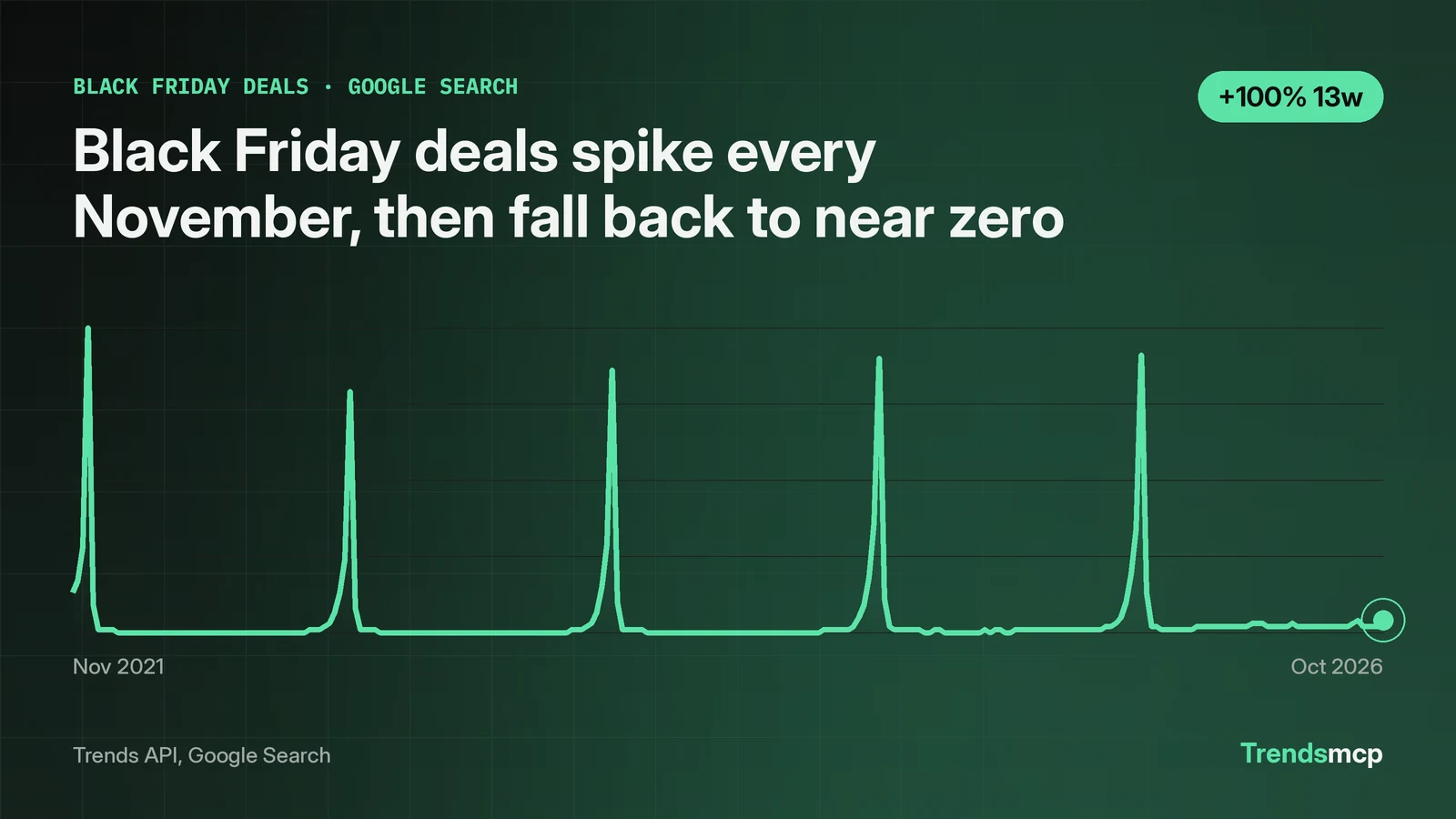
A trend counts as verified when four checks agree, and each check catches a different way a chart can mislead. First, fixed growth windows with both endpoints quoted, so a percent always carries the values behind it. Second, the five-year shape, which separates a repeating seasonal spike from a genuine breakout. Third, a second source saying the same thing, so one dataset never carries the whole claim. Fourth, the zero test, which exposes terms with no measurable demand at all. The worked example is "black friday deals" on Google Search, pulled November 11, 2026: the November spike repeats five years running, the October numbers sit near the floor, and news coverage lines up with early-deals stories.
A 100% jump can mean nothing, so quote the endpoints
"Black friday deals" rose 100% in 30 days and 100% in 90 days. That sounds like a breakout until the endpoints appear: 2 in the week of October 3 to 4 in the week of October 31, and 2 in the week of August 1 to 4 on October 31. A doubling from 2 to 4 on a 0 to 100 index is noise at the floor, not momentum. The 12-month window tells the calmer story: 5 in the week of November 1, 2025, to 4 on October 31, 2026, down 20% year over year. Same term, same day, three windows, three different impressions. The percent alone never settles which one to trust.
Quoting the window, both dated endpoints, and the percent is the habit that makes the number checkable. "Up 100% in 30 days" means 2 on October 3 became 4 on October 31, and only the full sentence with both dates is checkable. "Doubled in a month" on its own is not. Growth here compares the two endpoint weeks directly and never averages the weeks between them, so one odd week at either end moves the percent. Quoting the endpoints shows the reader exactly how much weight the number can carry. The call:
get_growth(keyword="black friday deals", source="google search", percent_growth=["12M", "90D", "30D"])
The five-year shape settles whether the spike repeats
A spike that repeats on the same calendar beat five years running is seasonality, and seasonality changes the decision completely: it says wait for the date, do not chase the slope. "Black friday deals" peaks in late November every year in the five-year record: 100 in the week of November 27, 2021; 79 in the week of November 26, 2022; 86 in the week of November 25, 2023; 90 in the week of November 30, 2024; and 91 in the week of November 29, 2025. Five peaks, five late Novembers, values between 79 and 100. Outside November, 124 of 239 weeks read 0 and 61 read 1; only the first December week climbs back to 8 to 13 as the tail of the spike. The recent September to October 2026 weeks read 2 to 4. The highest week in the whole 261-week record is the 100 from November 27, 2021.
The shape answers the question. The term is not breaking out. It is a calendar event with a steep ramp. As of November 11, 2026, the ramp has not started: the latest completed week is October 31, reading 4, so the first November 2026 week is unobserved. In past years the first November week read 5 to 13, the second 9 to 17, the third 18 to 29, and the peak week 79 to 100. The two years with five November weeks, 2024 and 2025, read 36 and 34 in the fourth week, between the third week and the peak. A content plan or a buying decision built on the 100% growth figure would be built on 2 becoming 4. The five-year view separates lasting demand from calendar noise, and it is the check that matters most for any term with a holiday attached. The Google Trends data guide explains the same five-year series and the weekly lag behind the numbers. The call:
get_time_series(keyword="black friday deals", source="google search")
A second source has to say the same thing
Ten News stories in seven days back the seasonal story, while the Reddit check returned nothing. That is the third check in action: what people are actually publishing about the term right now. A News context call for "black friday deals" over the last 7 days returned 10 stories, including a ZDNET piece from November 8, 2026, "Best early Black Friday deals: Up to 60% off deals at Amazon, Walmart, Costco, and more", and a Forbes piece from November 9, 2026, "The 45+ Best Early Black Friday Deals From HigherDose, West Elm And More". Retailers are already publishing early-deals coverage while the search index still reads 4. That reads as early coverage now with the search spike still to come, though the search data cannot confirm a future spike; it can only show the ramp has not started.
The Reddit check did not pass. A second context call, this time against Reddit, returned 0 items with the source marked unavailable, so there is no second social source in this run. A failed check is not a pass. It gets written down as failed, and the verdict rests on News alone for corroboration, plus the primary Google Search series. If a claim needs a social source to stand, the honest move is to wait for one. The calls:
get_context(keyword="black friday deals", source="News")
get_context(keyword="black friday deals", source="Reddit")
The zero test catches terms with no data at all
A probe of the nonsense keyword "zqxwvjkpt blorp" returned 261 weekly points, 260 of them zero, with a single 100 in the week of August 23, 2025. That lone 100 surrounded by zeros is not a spike. It is noise in an empty series, and any growth percent computed off it would be fiction. The rule is plain: most points zero is a warning, not a verdict. A lone 100 in an otherwise empty series fails the test; repeated peaks on a calendar beat pass it.
Run the same probe on any term before trusting its line. A seasonal term can sit at zero most of the year, so the test is not whether most points are nonzero. The test is whether the series has a shape: repeated peaks on a calendar beat, like the November spikes above, versus a lone 100 in an otherwise empty series. "Black friday deals" has 137 of 261 weeks above zero, and every zero falls outside November. The trend graph guide shows how to read that shape, and the trend data topic collects the series behind the site's own checks. The verdict is seasonal, not breaking out. The action is to wait for the ramp.