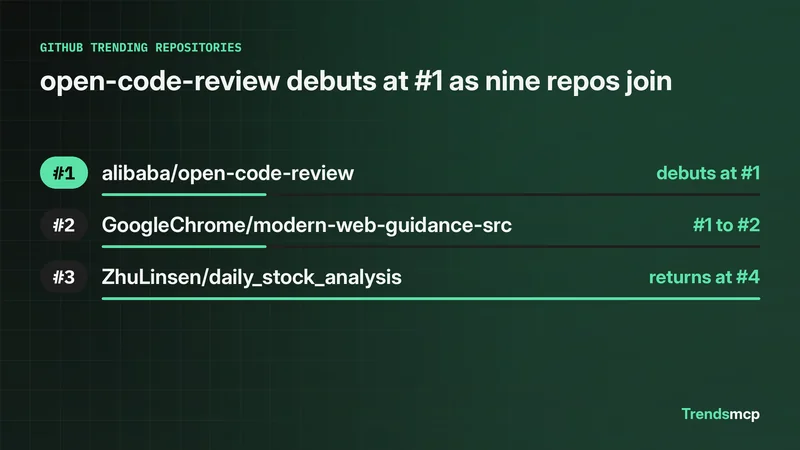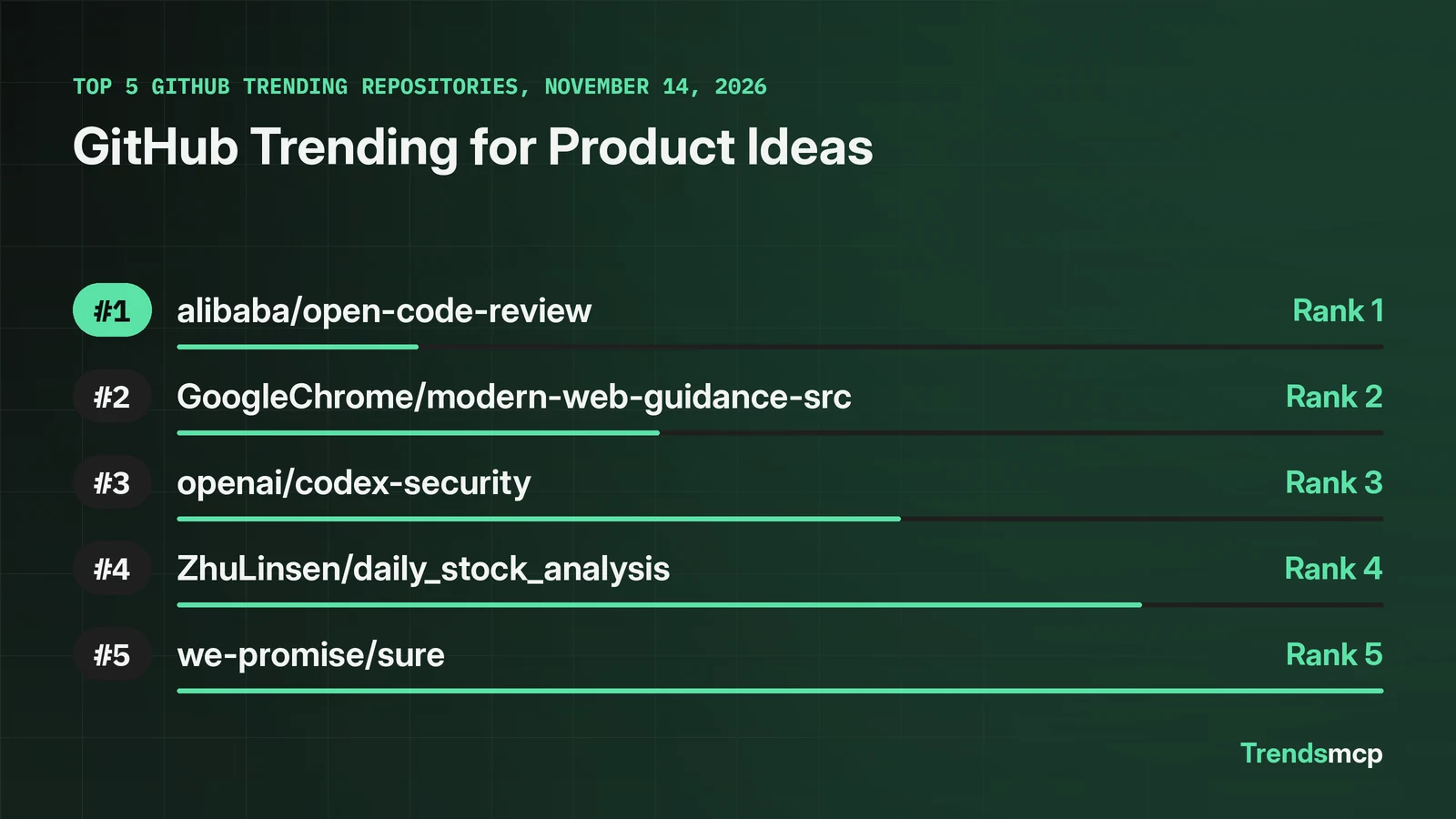
GitHub Trending lists the repositories gaining the most attention each day, and that list doubles as a product idea feed for anyone willing to read it as signal rather than a shortlist. The method has four steps. First, read the board and note what is rising. Second, sort entries by signal, such as repeat appearances and the kind of attention, rather than by rank alone. Third, validate the spike with a series check: a repo that holds attention over days tells a different story from one that flashes once. Fourth, decide build or skip against a written rule, and record the call. On November 14, 2026, the search term "github trending" drew 40,500 monthly searches with low competition, and the board's top five entries were alibaba/open-code-review, GoogleChrome/modern-web-guidance-src, openai/codex-security, ZhuLinsen/daily_stock_analysis and we-promise/sure. This guide runs the method on that board.
Step one: read the board as a feed, not a shortlist
The first pass collects; it does not judge. Open the board, read all ten entries, and write down each name and rank before forming any view about what to build. The daily GitHub Trending board for November 14, 2026 carries the full top ten for the day this guide uses as its worked example.
Rank and name are the only facts the board gives at a glance. Nothing on the board says what a project does, who uses it, or whether its attention will last past today. That limit is the point of step one: a feed read slowly beats a shortlist picked fast. Note the names, note the ranks, and hold off on conclusions until the later steps add evidence.
A useful habit at this stage is to mark entries whose names point at the same domain. On November 14, judging by names alone, two of the top five names point at code review and security tooling, and one entry in the lower half points at trading, pairing with the stock analysis entry at rank four. A pair like that is worth a mark in the notes. It is not proof of demand. It is a reason to look closer in step three.
Step two: sort by signal, not by rank
Rank measures attention today. It says nothing about attention tomorrow. Sorting by signal means asking, for each entry, what kind of attention it is getting and whether it has appeared before.
Three signals carry the most weight. The first is repetition: an entry that appears on the board on consecutive days has held attention, while a first-time entry at rank one may be a single-day flash. Compare the board with the previous day's board before deciding anything. The second is clustering: several entries in the same domain on one day point at a shared theme, such as developer tooling or trading, rather than a single project. The third is the source of the attention: a project tied to a well-known organization draws a different kind of curiosity from a project whose name shows no organization behind it, and the two need different validation. On this board, judging by names alone, openai/codex-security appears to carry a well-known organization name, while backnotprop/plannotator gives no such signal.
Apply the sort to the November 14 board and the picture changes. Judging by names alone, the top five entries mix code review, browser guidance, security tooling, stock analysis and a project whose name gives no hint of its purpose. Rank alone would put alibaba/open-code-review first and we-promise/sure fifth. Signal asks a harder question: which of these five has a reason to still matter next week. That question has no answer from rank alone.
Step three: validate the spike with a series check
A spike is a claim, and a claim needs a second source. The series check is simple: pull the GitHub board for three consecutive days and see whether the entry stays, climbs, or drops off. A repo that holds a place over the three days shows durable interest. A repo that appears once and vanishes showed a moment, not a market.
The TrendsMCP get_top_trends call for GitHub returns the board for a given date, so the check is a matter of pulling the same board across days and lining the results up. Search demand adds a second line of evidence. The term "github trending" itself drew 40,500 monthly searches with low competition in Google Ads Keyword Planner on November 14, 2026, which shows real demand for the board as a research habit. It does not show demand for any single repo on the board. Demand for a specific idea needs its own check: search volume for the problem the idea would solve, not for the board that surfaced it.
For the full verification routine, see how to verify a trend. The short version is this: one day of attention is a lead, three days of attention is a pattern, and search demand for the underlying problem is what turns a pattern into a candidate worth building.
Step four: decide build or skip with a written rule
Most entries on any board should end in skip. That is the method working, not failing. A written rule keeps the decision honest: build only when the entry passes the series check, when demand for the problem exists apart from the board, and when the reader can name the user and the job the product would do for that user. If any of those three is missing, the call is skip, and the reason goes in the notes.
Write the call down either way. A log of skips is as valuable as a log of builds, because it stops the same entry from being reconsidered from scratch next week. Over a month, the log shows which domains keep passing the series check and which ones only ever flash once. That record is the real output of the method: a short list of ideas that survived four steps, plus a clear account of why the rest did not.
What the November 14 board shows after steps one, two and four
Here is the full top ten for November 14, 2026, rank and name only, because those are the only facts the board states:
| Rank | Repository |
|---|---|
| 1 | alibaba/open-code-review |
| 2 | GoogleChrome/modern-web-guidance-src |
| 3 | openai/codex-security |
| 4 | ZhuLinsen/daily_stock_analysis |
| 5 | we-promise/sure |
| 6 | backnotprop/plannotator |
| 7 | louislam/uptime-kuma |
| 8 | block/buzz |
| 9 | tradermonty/claude-trading-skills |
| 10 | tailscale/tailcat |
Two observations follow from the names alone, and both need the caveat that a name is not proof of what a project does. First, the top of the board leans toward developer tooling: code review, browser guidance and security tooling fill three of the top five spots. Second, one entry in the lower half points at trading, which pairs with the stock analysis entry at rank four to form a two-entry pair around markets. The fifth entry, we-promise/sure, shows the limit of reading names: its purpose is not plain from its name, and guessing would be worse than saying so. Any of these entries would still need the series check from step three before it could count as a product lead. This worked example runs steps one, two and four on the November 14 board. Step three needs the boards from the following days, so it is described in the method above rather than demonstrated here. On the evidence in this guide alone, none of the ten has passed the series check yet, so none is a build call today.
Three traps that turn a trending repo into a wasted build
The first trap is building for rank. Rank one on a single day is the weakest signal on the board, and it is also the most tempting. A product built on one day of attention inherits that day's fragility.
The second trap is reading a name as a market. A repo named for stock analysis shows that someone built a stock analysis tool, not that buyers want another one. The market question is separate, and only demand data answers it.
The third trap is treating the board as proof. The board proves attention, and attention is the start of research, not the end of it. Skip the series check and the demand check, and the build rests on a single day of someone else's curiosity.
A weekly routine that keeps the board useful
The method pays off as a routine, not a one-off. Once a week, pull the board each day, run the four steps on the entries that repeat, and keep the log of builds and skips. The weekly trend scan sets out a cadence for this kind of review, and the GitHub board fits inside it as one feed among others.
Four steps, one board, one log. The board changes every day. The method does not need to.